Market liquidity a primera
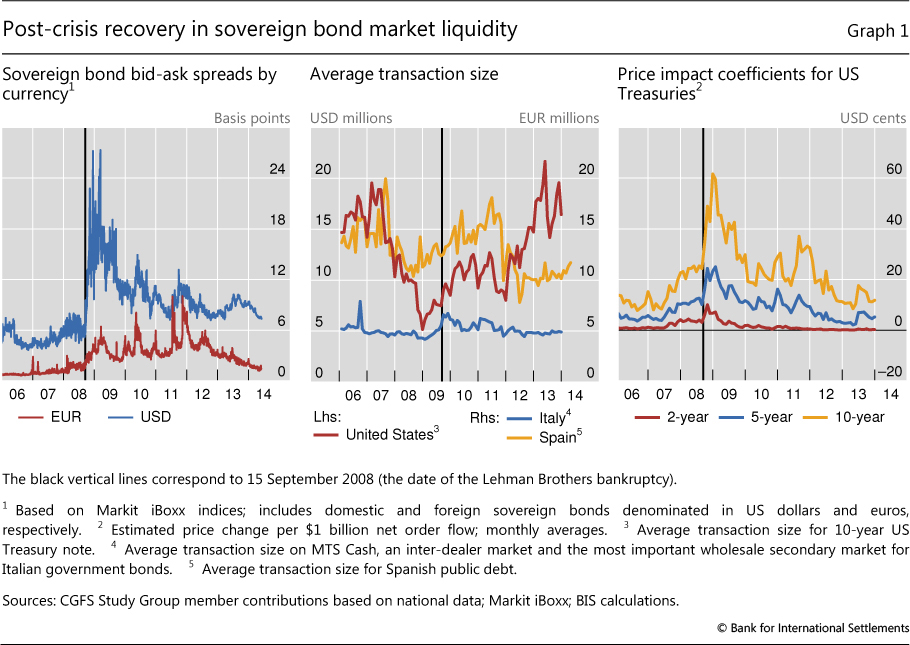
For the same asset, its liquidity can change through time or between different markets, such as in different countries. The change in the asset's liquidity is just based on the market liquidity for the asset at the particular time or in the particular country, etc. The liquidity of a product can be measured as how often it is bought and sold. Liquidity can be enhanced through share buy-backs or repurchases. Liquidity is defined formally in many accounting regimes and has in recent years been more strictly defined.
Other rules require diversifying counterparty risk and portfolio stress testing against extreme scenarios, which tend to identify unusual market liquidity conditions and avoid investments that are particularly vulnerable to sudden liquidity shifts.
A liquid asset has some or all of the following features: It can be sold rapidly, with minimal loss of value, anytime within market hours.
The essential characteristic of a liquid market is that there are always ready and willing buyers and sellers. It is similar to, but distinct from, market depth , which relates to the trade-off between quantity being sold and the price it can be sold for, rather than the liquidity trade-off between speed of sale and the price it can be sold for. A market may be considered both deep and liquid if there are ready and willing buyers and sellers in large quantities. An illiquid asset is an asset which is not readily salable without a drastic price reduction, and sometimes not at any price due to uncertainty about its value or the lack of a market in which it is regularly traded.
Before the crisis, they had moderate liquidity because it was believed that their value was generally known. Speculators and market makers are key contributors to the liquidity of a market or asset. Speculators are individuals or institutions that seek to profit from anticipated increases or decreases in a particular market price. Market makers seek to profit by charging for the immediacy of execution: By doing this, they provide the capital needed to facilitate the liquidity.
The risk of illiquidity does not apply only to individual investments: Financial institutions and asset managers that oversee portfolios are subject to what is called "structural" and "contingent" liquidity risk.
Structural liquidity risk, sometimes called funding liquidity risk, is the risk associated with funding asset portfolios in the normal course of business. Contingent liquidity risk is the risk associated with finding additional funds or replacing maturing liabilities under potential, future stressed market conditions.
When a central bank tries to influence the liquidity supply of money, this process is known as open market operations. The market liquidity of assets affects their prices and expected returns. Theory and empirical evidence suggests that investors require higher return on assets with lower market liquidity to compensate them for the higher cost of trading these assets. In addition, risk-averse investors require higher expected return if the asset's market-liquidity risk is greater.
Here too, the higher the liquidity risk, the higher the expected return on the asset or the lower is its price. One example of this is a comparison of assets with and without a liquid secondary market.
The liquidity discount is the reduced promised yield or expected a return for such assets, like the difference between newly issued U. Treasury bonds compared to off the run treasuries with the same term to maturity. Initial buyers know that other investors are less willing to buy off-the-run treasuries, so the newly issued bonds have a higher price and hence lower yield.
In the futures markets , there is no assurance that a liquid market may exist for offsetting a commodity contract at all times. Some future contracts and specific delivery months tend to have increasingly more trading activity and have higher liquidity than others. The most useful indicators of liquidity for these contracts are the trading volume and open interest. There is also dark liquidity , referring to transactions that occur off-exchange and are therefore not visible to investors until after the transaction is complete.
It does not contribute to public price discovery. In banking, liquidity is the ability to meet obligations when they come due without incurring unacceptable losses. Managing liquidity is a daily process requiring bankers to monitor and project cash flows to ensure adequate liquidity is maintained. Maintaining a balance between short-term assets and short-term liabilities is critical.
For an individual bank, clients' deposits are its primary liabilities in the sense that the bank is meant to give back all client deposits on demand , whereas reserves and loans are its primary assets in the sense that these loans are owed to the bank, not by the bank. The investment portfolio represents a smaller portion of assets, and serves as the primary source of liquidity. Investment securities can be liquidated to satisfy deposit withdrawals and increased loan demand.
Banks have several additional options for generating liquidity, such as selling loans, borrowing from other banks , borrowing from a central bank , such as the US Federal Reserve bank , and raising additional capital.
In a worst-case scenario, depositors may demand their funds when the bank is unable to generate adequate cash without incurring substantial financial losses. In severe cases, this may result in a bank run. Most banks are subject to legally mandated requirements intended to help avoid a liquidity crisis. Banks can generally maintain as much liquidity as desired because bank deposits are insured by governments in most developed countries.
To abstract from regional effects e. This highlights that while the US drives the global financial cycle through its monetary policy, other financial centres — the UK and the Eurozone — affect the global financial cycle through the conditions of their banks, consistent with their major global financial intermediation role Shin Borrowing countries may want to limit their exposures to global liquidity fluctuations to better control domestic financial conditions. This column summarized key stylized facts about global liquidity, building on existing literature and new results.
The fact that global liquidity is in large part driven by G4 conditions has both positive and negative implications for the rest of the world. Since access to foreign capital is good for economic development, accommodative conditions in G4 that boost cross-border flows can increase economic development and growth elsewhere.
Arguably, this has been one of the beneficial effects of current accommodative monetary policies in G4. But there is also scope for risks when too accommodative conditions in G4 contribute to credit booms elsewhere, or when a tightening in G4 triggers sudden stops in capital flows or even outflows from the rest of the world that test limits of macroeconomic policy management.
Balancing these effects, particularly in the context of a shifting, unconventional monetary policy cycle in advanced economies, will be challenging. Overall, our understanding of forces driving the global financial cycle is still in its infancy. For example, China may also be considered as a 'financial centre' economy, which funds the rest of the world. But the analysis of China's role in global liquidity is restricted by data availability. International finance Macroeconomic policy.
Systemic risks in global banking: What available data can tell us and what more data are needed? Economic rationale and optimal tools. Giovanni Favara, Lev Ratnovski. Why is global liquidity important? What drives global liquidity, i.
Where does the global financial cycle originate? Is it primarily US-driven, or do other financial centre economies play a role? How can a borrowing country manage its exposure to global liquidity fluctuations? What drives global liquidity? The literature highlights a number of domestic G4 factors that may affect credit supply in cross-border funding markets: Uncertainty and risk aversion, typically captured by VIX Rey ; Domestic credit conditions, captured as bank leverage high for more accommodative conditions, see Bruno and Shin , domestic credit growth Borio and Lowe , or TED spread.
We confirm, using US data, that all of these factors are important in driving cross-border credit: An increase in the term premium from its 25th to 75th percentile decreases cross-border lending to banks and real sector by 1. Which countries drive global liquidity? For monetary policy, US factors play an overwhelming role.
UK and Eurozone term premium, interest rates, and money growth are mostly not significant. Can countries manage their exposures to global liquidity? A better macro framework, such as a flexible exchange rate. The difference is smaller for cross-border flows to the real sector: Stricter capital controls also reduce cross-border inflows to banks from about Concluding thoughts This column summarized key stylized facts about global liquidity, building on existing literature and new results.
The EMU after the euro crisis: Insights from a new eBook. Brexit and the way forward. Deepening EMU requires a coherent and well-sequenced package. Spring Meeting of Young Economists Economic Forecasting with Large Datasets.
Homeownership of immigrants in France: Evidence from Real Estate.