Bitcoin commands information
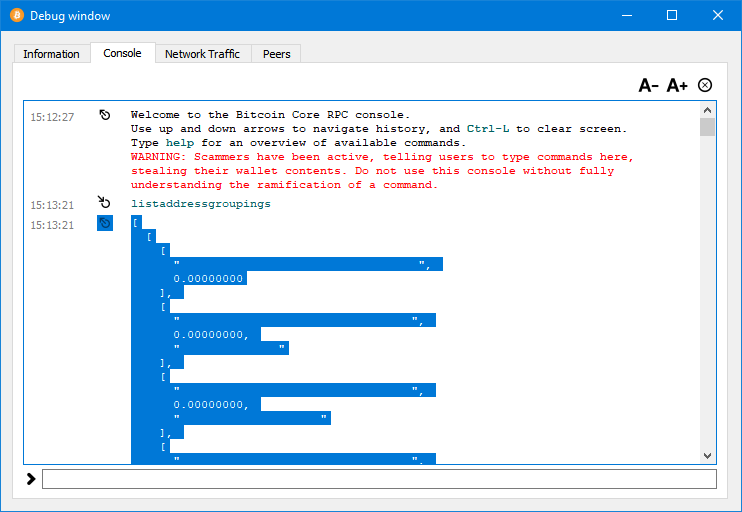
Managing wallet addresses addmultisigaddress nrequired ["key", Funds sent to this address can only be spent by transactions signed by nrequired of the specified keys.
Returns the P2SH address. Set verbose to true to get more information about each address, formatted like the output of the validateaddress command. For more control see the new listaddresses command. This creates one or more watch-only addresses , whose activity and balance can be retrieved via various APIs e. If rescan is true , the entire blockchain is checked for transactions relating to all addresses in the wallet, including the added ones.
Returns null if successful. Use count and start to retrieve part of the list only, with negative start values like the default indicating the most recently created addresses. For each key pair, the address , pubkey as embedded in transaction inputs and privkey used for signatures is provided. Returns an object containing the P2SH address and corresponding redeem script.
For global permissions, set permissions to one of connect , send , receive , create , issue , mine , activate , admin , or a comma-separated list thereof.
For per-asset or per-stream permissions, use the form entity. If the chain uses a native currency, you can send some to each recipient using the native-amount parameter. Returns the txid of the transaction granting the permissions.
For more information, see permissions management. It is useful if the node has multiple addresses with administrator permissions. To include raw data, pass a data-hex hexadecimal string. To list information about specific global permissions, set permissions to one of connect , send , receive , issue , mine , activate , admin , or a comma-separated list thereof. The permissions parameter works the same as for grant.
Returns the txid of transaction revoking the permissions. To create an asset with the default behavior, use an asset name only for name params. If open is true then additional units can be issued in future by the same key which signed the original issuance, via the issuemore or issuemorefrom command. The smallest transactable unit is given by units , e.
If the chain uses a native currency, you can send some with the new asset using the native-amount parameter. Returns the txid of the issuance transaction. For more information, see native assets. It is useful if the node has multiple addresses with issue permissions. The asset can be specified using its name, ref or issuance txid — see native assets for more information.
If the chain uses a native currency, you can send some with the new asset units using the native-amount parameter. In assets with multiple issuance events, the top-level issuetxid and details fields refer to the first issuance only — set verbose to true for details about each of the individual issuances.
Use count and start to retrieve part of the list only, with negative start values like the default indicating the most recently created assets.
Extra fields are shown for assets to which this node is subscribed. Use includeLocked to include unspent outputs which have been locked, e. Use verbose to provide details of transaction inputs and outputs.
The response includes a total of the balances shown. Use includeWatchOnly to include the balance of watch-only addresses and includeLocked to include unspent outputs which have been locked, e.
Use includeWatchOnly to consider watch-only addresses as if they belong to this wallet and verbose to provide details of transaction inputs and outputs. Use skip to go back further in history and verbose to provide details of transaction inputs and outputs. Use skip to go back further in history and includeWatchOnly to consider watch-only addresses as if they belong to this wallet. Use verbose to provide the details of transaction inputs and outputs.
In Bitcoin Core, the amount field is the quantity of the bitcoin currency. Use "" as the asset inside this object to specify a quantity of the native currency. See also sendasset for sending a single asset and sendfrom to control the address whose funds are used.
See also sendassetfrom to control the address whose funds are used, send for sending multiple assets in one transaction, and sendfrom to combine both of these. Any change from the transaction is sent back to from-address. See also sendfrom for sending multiple assets in one transaction. The txid and vout should generally be taken from preparelockunspent or preparelockunspentfrom.
Multiple items can be specified within the fourth parameter to request multiple assets. Returns a raw transaction in the hex field alongside a complete field stating whether the exchange is complete i. If complete, the transaction can be broadcast to the network using sendrawtransaction.
If not, it can be passed to a further counterparty, who can call decoderawexchange and appendrawexchange as appropriate. If the completed exchange is not balanced, an error is returned.
Optional metadata can be added to the transaction, signed by this user only. Returns a raw transaction in hexadecimal which can be broadcast to the network using sendrawtransaction.
The txid and vout should generally be taken from the response to preparelockunspent or preparelockunspentfrom. Multiple items can be specified within the third parameter to request multiple assets. Returns a raw partial transaction in hexadecimal which can be passed to the counterparty, who can call decoderawexchange and appendrawexchange as appropriate.
Returns details on the offer represented by the exchange and its present state. The candisable field specifies whether this wallet can disable the exchange transaction by double-spending against one of its inputs.
The cancomplete field specifies whether this wallet has the assets required to complete the exchange. The complete field specifies whether the exchange is already complete i. If verbose is true then all of the individual stages in the exchange are listed. Other fields relating to fees are only relevant for blockchains which use a native currency.
To check whether this can be used on an exchange transaction, check the candisable field of the output of decoderawexchange. Multiple items can be specified within the first parameter to include several assets within the output. The output will be locked against automatic selection for spending unless the optional lock parameter is set to false. Returns the txid and vout of the prepared output. Any change from the transaction is send back to from-address.
Pass the value "stream" in the type parameter the create API can also be used to create upgrades. If open is true then anyone with global send permissions can publish to the stream, otherwise publishers must be explicitly granted per-stream write permissions. Returns the txid of the transaction creating the stream.
It is useful if the node has multiple addresses with create permissions. Use count and start to retrieve part of the list only, with negative start values like the default indicating the most recently created streams. Extra fields are shown for streams to which this node has subscribed. Publishing stream items publish stream key data-hex Publishes an item in stream , passed as a stream name, ref or creation txid, with key provided in text form and data-hex in hexadecimal.
It is useful if a stream is open or the node has multiple addresses with per-stream write permissions. See also the autosubscribe runtime parameter. Set verbose to true for additional information about the transaction. Set verbose to true for additional information about each transaction. Use count and start to retrieve part of the list only, with negative start values like the default indicating the most recent items. Set local-ordering to true to order transactions by when first seen by this node, rather than their order in the chain.
Use the count-bytes and start-byte parameters to retrieve part of the data only. One or more blocks can be specified using their heights, hashes or timestamps — see the listblocks command for more information. Set verbose to true to include information about the first and last item with each key shown. See liststreamitems for details of the count , start and local-ordering parameters. Set local-ordering to true to order items by when first seen by this node, rather than their order in the chain.
Set verbose to true to include information about the first and last item by each publisher shown. This can improve wallet performance, especially for miners in a chain with short block times and non-zero block rewards. Only combines outputs with at least minconf confirmations, using between mininputs and maxinputs per transaction. A single call to combineunspent can create up to maxcombines transactions over up to maxtime seconds.
See also the autocombine runtime parameters. These will not be used when automatically selecting the outputs to spend in a new transaction. For a MultiChain blockchain, each transaction output includes assets and permissions fields listing any assets or permission changes encoded within that output.
If the third parameter is provided, only outputs which pay an address in this array will be included. If unlock is true , it unlocks the specified outputs, or unlocks all outputs if no second parameter is provided. Working with raw transactions appendrawchange tx-hex address native-fee Adds a change output to the raw transaction in tx-hex given by a previous call to createrawtransaction.
Any assets or native currency in the transaction inputs which are not claimed in the outputs will be sent to address , minus the native-fee which is calculated automatically if omitted. The returned raw transaction can be signed and broadcast to the network using signrawtransaction and sendrawtransaction. Raw metadata can be specified in data-hex in hexadecimal form. Alternatively, an object can be passed to represent asset issuance, stream creation or a stream item — see raw transactions for more details.
Note that if tx-hex contains more outputs than inputs, the new outputs will be inserted at position n , where n is the number of inputs in tx-hex. This is important to preserve the viability of certain types of transaction signatures. In Bitcoin Core, each amount field is a quantity of the bitcoin currency. The optional data array adds one or more metadata outputs to the transaction, where each element is a raw hexadecimal string or object, formatted as passed to appendrawdata.
The optional action parameter can be lock locks the given inputs in the wallet , sign signs the transaction using wallet keys , lock,sign does both or send signs and sends the transaction. If action is send the txid is returned. If action contains sign , an object with hex and complete fields is returned, as for signrawtransaction. Otherwise, the raw transaction hexadecimal is returned. See raw transactions for more details on building raw transactions.
One or more change outputs going back to from-address will also be added to the end of the transaction. The raw transaction can be created using createrawtransaction , optionally appendrawdata and signrawtransaction , or else createrawexchange and appendrawexchange.
Returns a raw hexadecimal transaction in the hex field alongside a complete field stating whether it is now completely signed.
If not, it can be passed to other parties for additional signing. To sign only part of the transaction, use the sighashtype parameter to control the signature hash type. Peer-to-peer connections addnode ip: For the entire ip: The command parameter should be one of add to manually queue a node for the next available slot , remove to remove a node , or onetry to immediately connect to a node even if a slot is not available. If this is a MultiChain blockchain, includes handshake and handshakelocal fields showing the remote and local address used during the handshaking for that connection.
The results are received asynchronously and retrieved from the pingtime field of the response to getpeerinfo. Messaging signing and verification signmessage address privkey message Returns a baseencoded digital signature which proves that message was approved by the owner of address which must belong to this wallet or any other private key given in privkey. The signature can be verified by any node using the verifymessage command.
The result is true or false unless an error occurred. Set verbose to 0 or false for the block in raw hexadecimal form. Set to 1 or true for a block summary including the miner address and a list of txids. Think of it as work done by groups of people to find large prime numbers or trying keys to decrypt a file. In fact, many wager that the DDOS attacks on many bitcoin-related services are direct action by hackers to inject instability in order to reduce the price.
As it stands, mining solo is very nearly deprecated. The process of finding blocks is now so popular and the difficulty of finding a block so high that it could take over three years to generate any coins. While you could simply set a machine aside and have it run the algorithms endlessly, the energy cost and equipment deprecation will eventually cost more than the actual bitcoins are worth. Pooled mining, however, is far more lucrative.
While this is simplified, it is basically how the system works. You work for shares in a block and when complete you get a percentage of the block based on the number of workers alongside you, less fees. The astute among you will note that I probably used twice that amount of electricity. My buddy Tom explained how to set up a pooled mining account so I thought it would be interesting to share the instructions.
You can either store your wallet locally or store it online. Wallets require you to use or download a fairly large blockchain file — about 6GB — so downloading and updating a local wallet may be a non-starter.
There is no preferred wallet type and there are obvious trade-offs to both. Privacy advocates would probably say a local wallet is best. You can download a local wallet here but make sure you keep a copy of your data backed up. This, without the period, is a direct way to send bitcoins to your wallet. Make a note of your address. In Coinbase, the wallet address found under linked accounts.
To mine in a pool you have to work with a group of other miners on available blocks. You can also try guilds like BTC Guild as well as a number of other options.
Pools with fewer users could also have a slower discovery time but pools with many users usually result in smaller payments. However, as one pool owner, Slush, notes:. First, create a pool login. The workers are sub-accounts with their own passwords and are usually identified by [yourlogin]. I have three workers running, currently — one on my iMac and two on my old PC.