Test bitcoin node
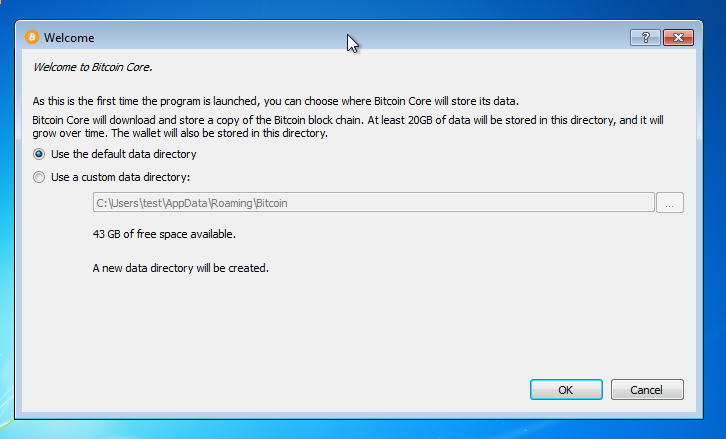
This mode is intended for test transactions and the development process. Twice before, people started trading these funds for real money, so the TestNet was reset twice, and all assets were lost.
Bitcoins stored in the TestNet do not and should not have any real value. The TestNet allows to fully simulate the behavior of the MainNet without risking real money or assets. Bitcoins are free and easy to mine. The minimal difficulty level is half of the minimal difficulty level of the MainNet, and if no block is mined in 20 minutes, the difficulty level is reset to the minimum value.
The Blockchain size is approximately GB. The Simulation Network is intended for tests on a local machine. This mode allows us to run your own, private network and to force the Bitcoin node to mine or generate blocks whenever we want.
Every action is done manually. If a transaction is sent, it will not be mined or confirmed until you run a specific command. I use this method to speed up the development and debug the transaction process, but because of the number of transactions that I can manually generate and confirm in one block, its use is limited, and I often receive empty blocks.
I strongly recommend to re-test all features with the TestNet or even the MainNet. The Bitcore installation process is fast if you know npm. The full operation is described at https: Bitcore requires you to install node. Bitcore is installed as an npm package with the following command. It will be installed globally.
To synchronize Bitcore with MainNet, run it with the bitcored command. This process will take approximately a week or so because the Bitcoin blockchain is about Gb at the moment. But for development purposes, we would like to proceed a little bit faster, omit this process and go straight to the next steps of our example. I would recommend switching to the TestNet mode Test network.
Bitcore does not support the SimNet mode Simulation network yet. TestNet is about Gb and will synchronize in at maximum a couple of hours if not faster. Because the TestNet does not operate on real money, it is better for development and test purposes — there is no need to have real Bitcoins or spend them. Thus, the possibility of losing funds is limited.
To run Bitcore in the TestNet mode, an additional node needs to be created by running the command: After that, a new directory will be created at mynode , where the Blockchain files will be stored. After the node is created with the config file above, it needs to be synchronized with the blockchain.
Enter the mynode directory which was created for TestNet and run Bitcore. A list of downloaded blocks will appear. They should be grouped in bunches of around each. At the very end of each information line, there will be progress information. Each block can be described with the hash and also a number, and these numbers are in a specific order.
The currently accepted block number can be previewed on every website dedicated to Bitcoin which also supports TestNet, e. So, at least you will know how many blocks there are to download and can calculate how much time your node needs to synchronize.
Bitcore can be connected with a user interface where all the information about the current state of the Blockchain can be presented. I am pretty sure that you are familiar with this interface.
Maybe the colors are different, or the place where buttons are located, but if you have even the most basic knowledge about Bitcoin, you probably visited sites like blockchain. Running commands on the command line can make the learning process faster, but copy-pasting the block and transaction hashes may be time-consuming during everyday work.
Therefore, I prefer to use the web interface to control what is published in the blockchain. Why do I not recommend you just visit an external page that will present all this information? It may happen that you will publish a transaction and want to see what happens with it before every other node on the internet will get information about it. Also, your node may be desynchronized has not downloaded all the blocks from the Blockchain.
So, if the transaction is on the Blockchain and your node doesn't know about it, you may miss this piece of information. To install the bitcore user interface, you just need to run: This will download the packages insight-api and insight-ui and run the npm installation process. The next time you start your node, the user interface will be available at http: After the node is synchronized, to operate with Bitcoin, a Wallet needs to be created.
This will allow you to not only review what is stored in the Blockchain but also send and receive transactions, create new addresses, etc. Most of the next steps will be done from the command line, but the information about the Blockchain state will be visible in the User Interface.
After a wallet or a new address is created, it can be previewed on the website. For now, Bitcore is able only to read the data from the Blockchain and does not support sending and receiving funds or managing wallets and addresses. We need to install additional software called the Wallet Service.
Other nodes do not need to operate with the local database but also do not provide a web interface, only the command line interface. This should automatically start the mongodb service in the background. Those steps will install the insight-api plugin for bitcore, the wallet-service, and the command line available from npm. Now, Bitcore should be restarted.
These steps provide us with the ability to operate on the wallets and addresses, but we still need to open a new wallet. The bitcore-wallet npm package adds two commands to the CLI — the wallet-create and the wallet. They allow us to operate on funds, addresses, and transactions, but first of all, the Wallet should be created.
The Wallet is the primary place where the funds are collected. The mechanism of Bitcoin assigns many addresses to a single Wallet. Now, bitcored can manage the funds that will be sent to one of its addresses. Because Bitcoin provides full anonymity and the transaction title, the sender's name or any additional information cannot be included in the transfer; we need to create a new address for each payment or sender.
All the funds received at the addresses that we will create will be automatically assigned to the wallet. The new address will be output. This address can be used to transfer funds to your wallet. However, the question is how to get the funds into TestNet. Mining requires a lot of computational power, time and does not give you any guarantees that it will succeed. Fortunately, Bitcoins available in the TestNet are free, and people like to share them.
You can use one of the websites that will send you Bitcoins when you enter the address, e. Information about my test transaction can be found at the address https: Remember that TestNet addresses and LiveNet addresses are different. If you enter the LiveNet address into one of those services, the funds will be lost, because the networks are totally separated and do not know about each other. Now, we have to wait for the Bitcoins to be transferred to our wallet.
The first step that will be done by the external application is to broadcast the information about a new transaction to the TestNet Blockchain. You can find this transaction by entering the transaction hash number into the User Interface that we installed.
It should have 0 confirmations. Don't worry if the UI cannot find this transaction. Check if the node is fully synchronized with the blockchain. It may take a little bit. The second thing that will happen is that the transaction will receive the first confirmation.
Now, the transaction is included in the last block and can be easily found in the Blockchain. From now on, the funds are in your wallet, assigned to the address that they were sent to. The third step is to get more confirmations. This will create the directory "mynode" in your current working and install all of the necessary dependencies and configuration files for your node. Note that you'll need to have txindex enabled in your bitcoin configuration file.
For installation instructions regarding the Bitcore Wallet Service, please see wallet service. Your node can run on "livenet" or "testnet". If you wish to configure the network, you can do so by opening the bitcore-node.
Then change the network value to "testnet" or "livenet". Here is an example configuration file:. This configuration includes an exec path to a locally compiled bitcoind and shares the datadir with standard. As mentioned previously, this process can take several hours to complete, so you can start the script and come back later to check on the status.
This will start up all of the services that have been enabled in your configuration file. The first service that will most likely be started is Bitcoin itself, followed by others that depend on it, such as the Database and Address Service. The syncing process will connect to other Bitcoin peers in the network and start downloading the blockchain, verifying proof-of-work, and creating indexes for querying the blockchain.
Both Bitcoin and the Database Service will log the status of the initial synchronization process. If you created your node by running bitcored instead of bitcore create mynode , your node will already have these services installed and you can skip this command.
While running individual CLI commands is a useful way to interact with your node, being able to view it in a GUI is even be better. Let's get started by installing the blockchain explorer Insight! This will run an npm command to download the packages insight-api and insight-ui and add them to your node's package. The next time you start up your node, the services will be enabled, and you'll be able to open your web browser to view the explorer.
Running a Full Node This tutorial will go over the basics of spinning up a Bitcore node.