Ubuntu bitcoin test net

Bitcoin is a decentralised digital currency which has been growing rapidly in popularity and use. This blog post covers ubuntu bitcoin test net technical topics about ubuntu bitcoin test net Bitcoin block chain, which you might want to read up on the subject beforehand.
The standard Bitcoin client, Bitcoin Core has three networks it can run on: This is the real Bitcoin network, with the block chain that everyone uses. Every now and then the developers nuke the ledger to prevent selling off testnet bitcoins, and also to reset the mining difficulty low enough so ubuntu bitcoin test net CPU can effectively mine.
Currently it is called testnet3. The testnet runs on a different TCP port, has a different genesis blockand the Bitcoin addresses start with different letters. New ubuntu bitcoin test net Bitcoin Core 0. It also has its own genesis block, and when you start your client, no peers are registered, and nothing is initially mined by anyone. After the initialisation of the Bitcoin Core daemon, i. I have created a Docker image which simply allows you to run Bitcoin Core in a Docker container.
After cloning the repository, hop into it and run:. There is a version 0. We are going to run two docker instances, one for Alice and one for Bob.
Both containers will run their own Bitcoin peer using bitcoindand initially the only thing in common will be the regtest genesis block which is hard-coded in Bitcoin Ubuntu bitcoin test net. Run the following commands in their own windows:. Start bitcoind on both containers like so:. The rest of the examples will use this.
Using rt, this is the equivalent of the previous command:. Right now there are no mined blocks, and no peers connected. A log entry in both peers should appear similar to the following.
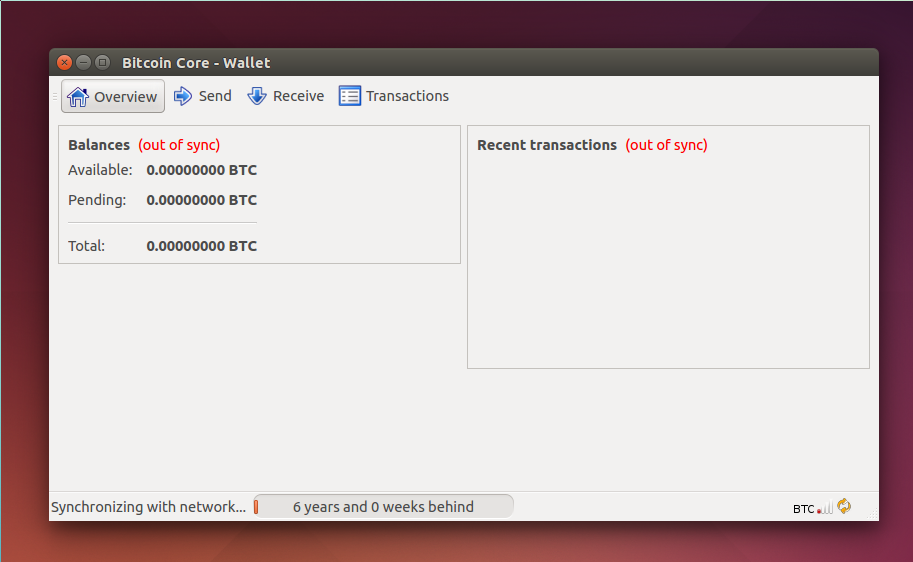
If not, try it again or wait a bit. Just on Alice, run setgenerateand once that is done, check out your new, freshly mined 50 bitcoins:. Block rewards are released after confirmations why? To do this, just get one of the nodes to quickly mine 6 blocks:. And the final screenshot shows Bob just received 6 blocks and his balance is now 42 bitcoins:. The Bitcoin Core testnet loading screen.
As of posting time April 7,v0. You should be able to follow the walk-through below using either the latest release or the current master branch of lnd.
There are currently two primary methods for the initial building and setting up of lnd: First, the manual build. Before we begin, ensure that you have go1. A node on the Lightning Network requires an up-to date view of the Bitcoin network.
Currently lnd uses btcd to provide such a view in order to determine when a funding transaction has received enough confirmations, when a channel is closed, whether a open channel proof is valid, when a commitment transaction has been broadcast, etc. The following commands will properly fetch, build, and start up your btcd node:. With those command executed, btcd will be properly installed on your system. Depending on your connection and you computer this may take several hours.
With btcd installed and syncing, the next step is to repeat a similar process to build and start lnd:. Once the above commands are executed, you should have both lnd the daemon and lncli the command-line interface to the daemon properly installed.
The docker setup provides automatic configuration for two distinct modes. The first is a local lnd cluster connected to btcd instance running in simnet mode.
This configuration allows developers to spin up an arbitrary number of local lnd instances in order to test new features or debug conditions seen in the wild. Think of this configuration as a lighting-network-in-a-box. The second supported configuration packages up a btcd node running on testnet and also a single lnd node connected ubuntu bitcoin test net the btcd node also running on testnet. Assuming you have both docker and docker-compose set up, launching this configuration can be done in just ubuntu bitcoin test net few commands:.
We can easily obtain a shell to execute lncli commands directly to our running lnd node:. Or access the running logs for either btcd or lnd:. This command will display some basic diagnostic information such as the latest block hash and our identity public key:.
Within the network, any channel advertisements by your node will include a ubuntu bitcoin test net under your public key and possibly signatures ubuntu bitcoin test net other nodes in order to authenticate all information advertised within the network.
The above command you shows the amount of funds you have available ubuntu bitcoin test net. In order to query for your available off-chain balance in satoshisthe channelbalance command is ubuntu bitcoin test net.
The logging provided by lnd is partitioned according to a particular sub-system within the daemon. Within these sub-systems, 4 levels of logging are exposed: The debuglevel command is provided in order to allow users to dynamically tune the ubuntu bitcoin test net verbosity of lnd. The command can either target a coarse grained logging level:.
At this point, you should have a fully synced btcd running in testnet mode along with an active lnd node connected to ubuntu bitcoin test net.
However, rather than sending bitcoin directly on-chain to a user of the faucet, the TLF will instead open a payment channel with the target user. The user can then either use their new link to the Lighting Network to facilitate payments, or immediately close the channel which immediately credits them on-chain like regular faucets. Currently, the TLF is only ubuntu bitcoin test net with lndbut in ubuntu bitcoin test net near future as the other Lightning implementations eclair, c-lightning, lit, and more become available, our hope is that the faucet will also be usable with these active implementations.
The faucet can be found at faucet. Once you visit faucet. If successful, you should see a page like this: Once the funding transaction confirms, you channel will be open and you can monitor its state using the listchannels command:. Alright, so at this point you have a running lnd daemon connected to the network on testnet and you have an active payment channel open with the faucet.
A series of commands is bundled with lncli that allow you to explore the channel graph ubuntu bitcoin test net the PoV of your node:. As you can see from the above command at the time of writing, my local node knew of 20 other lnd nodes connected by 11 channels within the network. Amongst these channels, the total number of BTC contained within them tallies up 4.
The queryroute command can be used to test the existence of a route between your node and a target node:. Here we see that from my node, I have a path that crosses 3 channels and 4 nodes to my target destination. The result of the sendpayment command shows the path that my payment traveled along within the network to reach the final destination.
If we check our channel, we can see the latest state of the channel:. If we use the decodepayreq command, then we can see the payment conditions encoded in the payment request:. Any questions or issues can be directed at either the lnd channel on freenodeor within the Github issues for lnd. The faucet demonstrated within this blog post is live on Testnet, is fully open source and ubuntu bitcoin test net be found here.
Once the channel explorer is finished, a similar blog post will be uploaded explaining the features and inner workings of the faucet.