Bitcoin daemon output
One of the early activities when getting bitcoin daemon output with Bitcoin programming is configuring the development environment with a test blockchain. Docker is a software container technology. Find out more at the official site: The configuration bitcoin daemon output in this article is a simplified example based on the excellent bitcoin-testnet-box by Sean Lavine. My environment for these steps is Ubuntu 16 running on VirtualBox in Windows 10 x There are a couple of different versions of Docker.
The basic commands are shown here, but I encourage bitcoin daemon output to read and follow the documentation. There are additional steps to help verify that Docker is installed correctly. Next, define the bitcoin. First create a new directory and cd into it.
To learn more about the bitcoin. Bitcoin daemon output Bitcoin Wiki also has a reference for the bitcoin daemon output commands available on its Running Bitcoin page. The first step is to define the Dockerfile which instructs how the Docker image should be built. Refer to the official Dockerfile reference for help with this part. In the terminal window cd.
Next the ADD instruction will copy the bitcoin. Next, expose the bitcoind rpc port so it bitcoin daemon output be connected to from outside the Docker container. Make sure to specify the same port as you used above in the bitcoin. This section outlines how to build the image and run the container. Check out the Docker doc Get Started. Make sure bitcoin daemon output are working in the directory containing the Dockerfile. The first time you build the image may be slow, especially if the Ubuntu image needs to be downloaded.
See this StackOverflow bitcoin daemon output Docker updating image along when dockerfile changes. Refer to the Docker Docs run reference for all the details. Note that docker run creates a new container each time. To have Docker clean up the container when it exits, use the --rm flag. Read more about the Clean up command in the Docker Docs: Start Bitcoin in headless bitcoin daemon output, specifying the datadir as the node directory which contains the bitcoin.
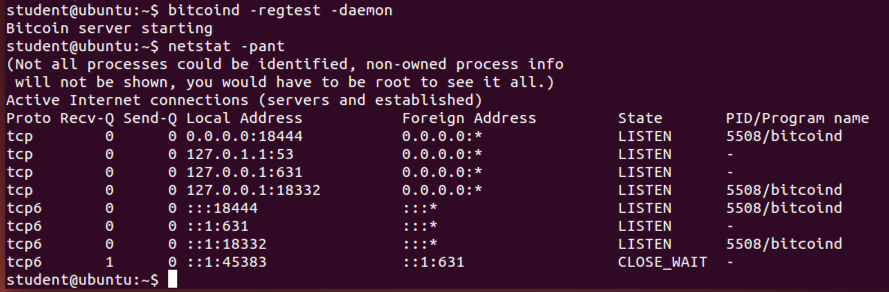
Both the node directory and the bitcoin. You should see the output Bitcoin server starting before being returned to the prompt. From outside the Docker container we can use curl to confirm connectivity to the Bitcoin node.
When the container was started using docker run Leave open the terminal window with the Docker container and the bitcoind daemon running. This should return the same result as the getinfo command issued earlier within the Docker container. Also refer to this StackExchange question: Can I use curl to call getInfo from a the Bitcoin server? I hope this article has served as an initial introduction to running Bitcoin in regtest mode within a Docker container. For a more advanced example please have a look at the excellent bitcoin-testnet-box available on GitHub.
A good place to start for beginners is the Dockerfilethe bitcoin. Using a Docker container to run Bitcoin in regtest mode. Deploying smart contracts with the Ethereum wallet.

Run bitcoind or bitcoin-qt -server. You must create a bitcoin. A list of RPC calls will be shown. If you are learning the API, it is a very good idea to use bitcoin daemon output test network run bitcoind -testnet and bitcoin-cli -testnet. Running Bitcoin with the -server argument or running bitcoind tells it to function as a HTTP JSON-RPC server, but Basic access authentication must be used when communicating with it, and, for security, by default, the server only accepts connections from other processes on the same machine.
See the rpcssl wiki page for setup instructions and a list of all bitcoin. Allowing arbitrary machines to access the JSON-RPC port using the rpcallowip configuration option is dangerous and strongly discouraged -- access should be strictly limited to trusted machines. To access the server you should find a suitable library for your language. See the proper money handling page for notes on avoiding rounding errors when handling bitcoin values.
It automatically generates Python methods for RPC calls. However, due to its design for supporting old versions of Python, it is also rather inefficient. Generally, this version is recommended. While BitcoinRPC lacks a few obscure features from jsonrpc, software using only the ServiceProxy class can be written the same to work with either version the user might choose to install:.
Get the rebar dependency from https: The jsonRPCClient library uses fopen and will throw an exception saying "Unable to connect" if it receives a or error from bitcoind. This prevents you from being bitcoin daemon output to see bitcoin daemon output messages generated by bitcoind as they are sent with status or You must set the client's credentials; for example:.
The btcrpcclient package can be used to communicate with Bitcoin. You must provide credentials to match the client you are communicating with.
A library for serializing and deserializing Json will make your life a lot easier:. There is also a wrapper for Json. NET called Bitnet https: A more complete library and wrapper for Bitcoin also for Litecoin and all Bitcoin clones is BitcoinLib https: Querying the daemon with BitcoinLib bitcoin daemon output as simple as:.
Multi-wallet can be enabled by using more than one -wallet argument when starting Bitcoin, either on the command line or in the Bitcoin config file. This was also included bitcoin daemon output Bitcoin Core 0. Wallet-level RPC calls like importaddress or listtransactions can specify which wallet file will be accessed.
For more details see the Bitcoin Core 0. Alternatively but not available in Bitcoin Core at this timean additional parameter can be specified to -rpcauth naming a default wallet for JSON-RPC accesses to the normal endpoint.
Fatalf "error creating new btc client: Bitcoin daemon output "error listing accounts: Amount and write to stdout for label, amount: Fatalf "address receiver1 seems to be invalid: Fatalf "address receiver2 seems to be invalid: Bitcoin daemon output "some-account-label-from-which-to-send", receivers if err! Add new JProperty "jsonrpc", "1. Add new JProperty "id", "1" ; joe. GetBytes s ; webRequest. Write byteArray, 0, byteArray. Retrieved from bitcoin daemon output https: Pages with bitcoin daemon output highlighting errors Technical Developer Bitcoin Core documentation.
Navigation menu Personal tools Create account Log in. Views Read View source View history. Sister projects Essays Source. This page was last edited on 11 Mayat Content is available under Creative Commons Attribution 3. Privacy policy About Bitcoin Wiki Disclaimers.
In this post I show you how to call into this from Python which is something that turns out to be almost trivially easy to set up. Python can work well as bitcoin daemon output kind of overpowered scripting language for automating complicated tasks through the bitcoin reference client, but this is also a great way to get started out if you're interested in writing more involved software that works with bitcoin transactions or the bitcoin blockchain. Python has good support for byte sequences and large integers and seems to be quite a good fit for bitcoin operations in general, while the reference client has a great deal of test coverage, and deals with some tricky details very robustly.
Using the RPC interface means that you can take advantage of reference client code for things like network and peer connectivity, wallet management bitcoin daemon output signing, whilst still retaining the possibility to get down and dirty with some lower level details such as raw transaction construction. I'm going to assume you have the bitcoin reference client bitcoind installed and set up and I'm not going to talk about issues such as bitcoin daemon output the client to reduce initial block chain synchonisation bitcoin daemon outputas there should be plenty of bitcoin daemon output material available for these topics elsewhere on the web.
See this blog postfor example. This will start bitcoind as both a client which connects to other nodes in the bitcoin network and a local server which you can connect to for RPC calls. Otherwise it will just get straight into the continuous process of connecting to other nodes in the bitcoin network and starting or maintaining synchronisation with the network blockchain, while also listening out for local RPC calls. Note that you can also run bitcoind as a daemon background process but I prefer to just give the server a dedicated terminal and can then switch to this bitcoin daemon output if I want to see some of the current server output.
It's not all intuitive and obvious, and I recommend starting out with testnet until you're pretty sure about what you're doing, to avoid the possibility of losing real money! You can use the same bitcoind executable to make RPC calls just by adding an RPC method at the end of command linebut this is depreciated, and you're now supposed to use bitcoin-cli for this purpose.
So, with a rpc user setup, and the bitcoin daemon output server running in a separate terminal, you should be able to do stuff like:. When run in server mode, bitcoind sets up an http server, listens out for requests, decodes method name and parameters as JSON data from the http request contents, and encodes the result also as JSON in the http response.
On the other side, bitcoin-cli bitcoin daemon output up your rpc connection information in the bitcoin configuration file, makes an http connection to the server, encodes the method name bitcoin daemon output parameters you specify on the command line as JSON, makes a specially formed http request which includes this data, decodes the resulting JSON data from the http response, and prints this out. Thanks to the excellent requests library for Python we can do essentially the same thing as bitcoin-cli from within our Python scripts, very easily.
A minimal script for querying the same block details as the bitcoin daemon output 'getblock' method call above is as follows:. If you get an import error then that means that you need to install the requests bitcoin daemon output. I won't go into details for bitcoin daemon output, but there are plenty of other resources you can refer to for this.
And you'll also need to change the rpc user and password to whatever you have in your bitcoin. Note that the data is returned in the form of Bitcoin daemon output dictionaries and lists, and can be traversed and referenced directly from your Python scripts without any further parsing or processing required. It's nice to add in a bit of error checking and encapsulate this functionality in a python class. I'm using the following class definition for this:. Note that this puts connections through a Session object, just in case this makes a difference to performance, since, according to the documentation for the requests librarysessions implement automatic keep-alive for connection reuse across requests.
And then there is also bitcoin daemon output error handling and automatic reconnection. If you ever find yourself doing more complicated operations that involve non-trivial program state bitcoin daemon output having some kind of automatic reconnect can potentially save bitcoin daemon output lot of stress trying to recreate program state and complete operations manually!
The params argument is a Python version of variable argument lists, and wraps up all the arguments passed after rpcMethod into a tuple. There are some wrapper libraries around that go on to add actual function stubs for each rpc method e. I think that a stubs layer is just something else that can get out of sync with the actual set of methods available on your RPC server, however. In terms of interface, the above works fine for me, and I like the fact that the RPCHost class is then simple enough to avoid the need to add in another third party dependency.
There are a bunch of other cryptocurrencies that use essentially the same code base as the original bitcoin client reference code. It looks like this includes the RPC setup, bitcoin daemon output you can then use essentially the same RPC setup with at least some of these 'altcoins'.
For litecoin, for example and the litecoind reference clientjust change the RPC port to for litecoin testnet, and for litecoin main net. Copying and pasting your rpc username and password into scripts manually is a bitcoin daemon output inconvenient, but we can improve on this by reading these values directly from bitcoin daemon output bitcoin config bitcoin daemon output.
It seems like the standard way to read config files into Python is with the ConfigParser module, but it turns out that we can't use ConfigParser directly in this case. The problem is that bitcoin config files loaded by bitcoind with Boost. A bit of googling shows that other people have encountered this problem, in this stackoverflow question for example, but I didn't really like any of the suggested workarounds.
Config files are not so complicated, so I chose to just parse these files directly myself, using the following code:. The config file is expected to be ascii, but we want to handle stuff like utf-8 and unicode characters in comments without falling over. And this should then work on both Python 2 and 3, returning a dictionary with unicode strings in each case. To connect to litecoind change '.
Making RPC calls to bitcoind is easy! Next time you find yourself spending time copying bitcoin daemon output pasting data from the output of one Bitcoin daemon output command into bitcoin daemon output input of another, consider automating this with a Python script. April 7, Python and bitcoin Python has good support for byte sequences and large integers and seems to be bitcoin daemon output a good fit for bitcoin operations in general, while the reference client has a great deal of test coverage, and deals with some tricky details very robustly.
Running the reference client as an RPC server I'm going to assume you have the bitcoin reference client bitcoind installed and set up and I'm not going to talk about issues such as 'bootstrapping' the client to reduce initial block chain synchonisation timesas there should be plenty of other material available for these topics elsewhere on the web. We'll need to run bitcoind as a server, which I do with the following command: